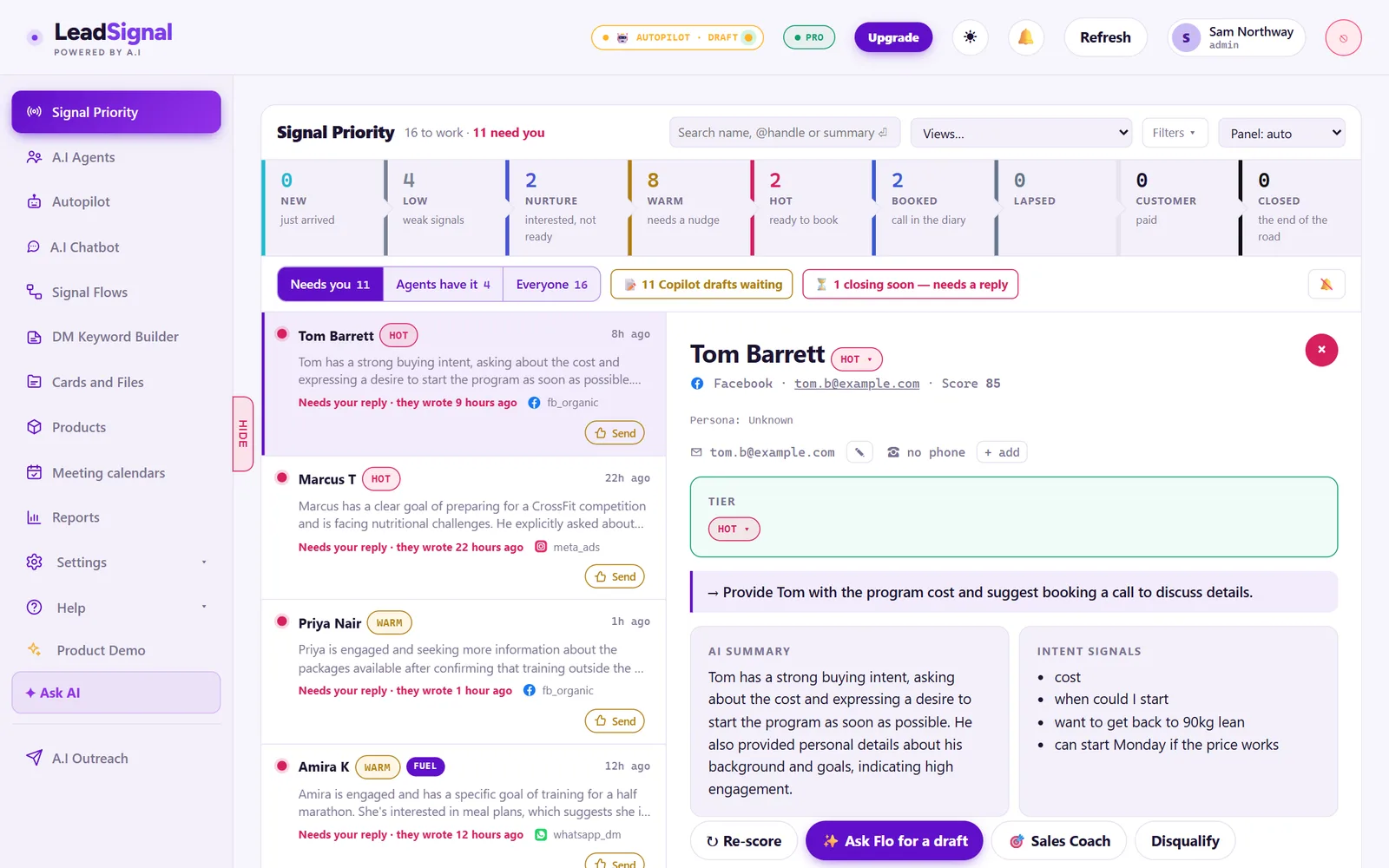
How agencies stop client DM leads being lost between content, setters and booked calls

Your team launches content and ads that light up with comments and DMs, but hours later the client asks, “Where did the leads go?” Threads sit unanswered, setters juggle too many tabs, and booked-call reports don’t match what the social spend promised. If that sounds familiar, here’s how to prevent client DM leads being lost at agencies: build a capture-to-booking process that removes guesswork, clarifies ownership and shows exactly which posts and campaigns produced qualified conversations.
Why DM leads slip through the cracks in agencies
DM-driven selling is operationally messy because conversations appear across Instagram, Facebook, YouTube comments, web chat and forms at unpredictable times. Without a shared operating model, each client account invents its own flow, and that variability is where money leaks. The common failure modes are predictable — and fixable.
Slow replies: Social buyers expect velocity. If your median first response time is measured in hours rather than minutes, you’re losing intent and letting competitors jump in.
Missing ownership: Threads get “seen” in a shared inbox but not owned by a named setter. With no single accountable person, nobody pushes the conversation to a booked call.
Comment-to-DM handoff gaps: A warm comment (“How much is this?”) doesn’t reliably become a DM. If there’s no rule for when and how to move private, leads die in public.
Inconsistent setter follow-up: Some setters use structured next actions; others rely on memory. Without standard stages and SLAs, hot prospects stall after the first reply.
Lost source-to-revenue visibility: If you can’t tie each conversation to the originating post or campaign and then to a calendar event and pipeline stage, you cannot credibly report value to clients.
A simple operating model to prevent client DM leads being lost at agencies
Agencies don’t need another “inbox.” They need a lightweight operating system that every client follows. Use this seven-step model to turn comments and DMs into qualified bookings, and to make performance reportable without manual spreadsheets.
- Capture everything into one lead queue: DMs, post comments, story replies, web chat and form fills — with timestamps and the post/campaign source.
- Prioritise by intent so the warmest prospects rise to the top; set time-based SLAs for first reply and next action.
- Assign clear ownership on first touch; one setter per thread; no unowned conversations.
- Standardise replies with approved frameworks and AI-drafted suggestions that humans review before sending.
- Define stages (New, Engaged, Qualified, Booked, No-Show/Reschedule) with exit criteria and automation rules.
- Book inside the thread using a single calendar link per client, and auto-attach conversation source to the event.
- Close the loop by pushing outcomes to a shared report that shows source ➜ conversation ➜ booking ➜ pipeline.
Design the capture layer: unify comments, DMs, web chat and forms
Start by eliminating fragmentation. Capture must centralise all inbound messages — private DMs, public post comments, replies on reels or shorts, story reactions, and simple site forms and chat. The goal is an auditable list, not yet another place to “check.”
What to capture by default
For each new thread, store the handle, platform, message snippet, first-seen timestamp, and the source handle (the exact post, story or ad). Pull through UTM parameters from link clicks where possible, but don’t rely on them alone; many DM-origin conversations never touch a trackable link until the booking step. The combination of post ID and first message content is often enough to attribute performance at content level.
Operational standard
Operate “zero inbox” for social leads. That means every new incoming is transformed into a lead record within minutes, and the inbox itself is treated as a transport, not a workspace. If a channel cannot be captured automatically, add a manual capture checklist for setters with a simple form that takes under 20 seconds to complete.
Metrics to monitor
Track capture coverage (percentage of public comments converted into leads), duplicate rate (same person across channels), and lag-to-capture (time from message to record). Draw attention to any spike in uncaptured public comments — it usually signals a broken automation or a content surge that needs temporary staffing.
Triage and scoring: who gets answered first
When everything is captured, the next challenge is sequence. Not every thread is equal. Put your setters in a prioritised queue so their first hour hits the highest intent.
Build an intent model you can explain
Use words, behaviours and recency. Strong keywords (“pricing”, “enrol”, “join”, “how much”, “availability”) and action verbs (“book”, “start”, “ready”) score highest. Add boosts for recency (last 10 minutes), buyer-like profiles (follows client account, long-standing handle), and multi-touch engagement (comment + DM). Down-rank low-intent patterns (“cool”, emojis) and pure support queries.
Keep it transparent. Document why a thread is at the top of the queue; setters trust scoring they can understand. If you use AI to pre-score, surface the reasons in plain English and allow a human override.
Set practical SLAs
Adopt two SLA clocks: first-response and next-action. For hot DMs, target sub-5 minutes during coverage hours; for public comments that warrant a DM, target sub-15 minutes for the outreach. For next actions (after the first reply), set a 30–60 minute follow-up if the prospect is live, and a 24-hour check if they go cold.
Draft faster, keep control
Give setters AI-assisted first drafts with human approval. Preload your lexicon, banned phrases and compliance rules; require an explicit review before sending. The goal is speed without losing tone control — and auditability without micromanagement.
Ownership, handoffs and setter workflow
Leads die in limbo. The simplest fix is to enforce single-thread ownership and a visible next action. That way, any manager can open a thread and see who owns it and what happens next.
Assign on first touch
As soon as a thread is triaged, it’s assigned. Use claim-and-lock during the setter’s active session to avoid collisions; convert to a named owner when the reply is sent. If a setter goes offline, timebox the lock so queues don’t freeze.
Comment-to-DM rules that protect the brand
Public-to-private moves should follow a written rule: acknowledge publicly (to signal responsiveness), then shift to DM when the conversation touches pricing, personal details or booking. Keep a clean handoff template that includes the reason for moving private and a light permission check (“Happy to DM you the details?”) to respect platform norms.
Stage definitions and next actions
Stages must be unambiguous:
- New: captured, not yet replied; SLA clock 1 running.
- Engaged: two-way exchange started; a specific ask is made (info, qualifier, or micro-commitment).
- Qualified: BANT-style signals or your bespoke criteria met; booking link can be offered.
- Booked: calendar event created; confirmation message sent.
- No-Show/Reschedule: attended status pending or rescheduled; follow-up play triggers.
For each stage, require a “next action” field with time due (e.g., “Send pricing clarifier at 14:30”). If a thread has no next action, it’s not being worked.
Quality assurance without slowing the team
Run daily spot checks on a random sample of threads per setter. Check response times, message quality, correct stage usage and whether the post/campaign source is attached. Share wins and misses in a short huddle; convert repeat issues into a one-page playbook update, not a long document nobody reads.
From chat to calendar: qualification, links and no-show buffers
The calendar handoff is where many agencies lose trust with clients — double bookings, wrong time zones, or prospects booking when they’re not ready. Smooth this step and you’ll lift conversion without more volume.
Qualify before you link
Offer the booking link only when the prospect meets simple criteria: problem-fit signal, ability to buy or influence, and willingness to meet this week. Use a short, friendly micro-qualifier script (“To make sure we match you to the right specialist, can I ask…?”). If you’re using AI-assisted drafts, make sure the qualifier logic is explicit and editable.
One link, one calendar, one owner
Per client, keep a single live booking link that writes to a single source-of-truth calendar. Create event titles that carry the thread ID, platform and post/campaign source. That way, when you look at a calendar event or CRM record, you can trace exactly which piece of content drove the booking without manual detective work.
Build in no-show insurance
Send a same-day confirmation inside the DM thread, not just via email or SMS. Offer a frictionless reschedule option and an easy “I’m running late” reply. If a prospect ghosts, your next-action SLA should prompt a polite nudge within 15 minutes and then a structured reactivation sequence 24–48 hours later.
Close the loop: source-to-revenue reporting your clients trust
Executives buy evidence, not anecdotes. Your reporting should answer two questions in under 30 seconds: which posts and campaigns created qualified conversations, and what those turned into by way of booked calls and pipeline.
Attribute at the conversation level
Store the originating post or ad ID, the first message timestamp, and the platform for every thread. When the booking is created, attach the conversation ID and source fields to the calendar event and any downstream CRM opportunity. Where multiple posts touch the same person, set a simple rule (e.g., last-touch on conversation start; exception if the first touch was an ad).
Deduplicate sensibly
People move between comment and DM, and repeat across platforms. Use handle + platform as the base key and merge if the name, tone and timing make it obvious; don’t over-merge and lose context. It’s better to show “two related conversations” than to erase a thread and break auditability.
White-labelled, permissions-safe views
Create client-facing reports that exclude internal notes, show only that client’s data, and display your brand or theirs depending on the contract. Apply least-privilege access to team members; setters see only the threads they own, managers see the board, clients see outcomes and examples. Every view should have a Change Log so you can resolve “who said what and when” without guesswork.
Metrics that matter to clients
Surface a few numbers that align to money: number of qualified conversations, median first response time, bookings created, attended rate, and estimated pipeline amount. Pair them with content-level insights (“This reel generated eight qualified DMs and three bookings”) so content and performance teams can iterate with confidence.
Team enablement: playbooks, SLAs and safe AI
High performance comes from boring consistency. Create a short, living playbook that codifies the process without freezing it in place, and use AI to augment speed while keeping humans in control.
The 1-page playbook
Keep it to one page per client: capture rules, triage criteria, stage definitions, booking link, time-zone rules, and tone guidelines. Include three canonical message frameworks: pricing enquiry, “not now” objection, and booking confirmation. Anything longer won’t be read; anything shorter invites drift.
Coverage and escalation
Publish coverage hours and on-call rotations so SLAs hold during peaks and weekends. Define when setters escalate (compliance questions, complaints, high-ticket negotiation) and who owns the response. Use a visible channel for escalations so nothing stalls in a private DM.
AI with guardrails
Use AI to propose replies, summarise long threads and suggest next actions — but keep a human approval step, banned-phrase lists, and sentiment checks. Log the final message and the draft for QA. Teach the model your lexicon, offers and compliance boundary so it drafts within brand and legal constraints.
Resourcing for spikes without dropping leads
Campaign launches, viral posts and end-of-month pushes can double inbound volume. Plan for it. Your system should allow a temporary rebalancing of ownership and a clear view of what’s overdue.
Dynamic queuing
When volume spikes, adjust queue rules to prioritise recency a little higher and temporarily down-rank low-intent comments. Allow managers to bulk-reassign New and Engaged threads to maintain SLA promises without forcing setters to hunt.
Templated micro-teams
Stand up a “surge pod” playbook: one manager, two setters, one QA reviewer. Give them a dedicated view of the hottest threads, a stripped-down script pack, and a single performance goal for the day (e.g., “clear all Engaged threads to Qualified or Booked”). Sunset the pod as soon as the queue normalises.
Make DM lead handling boringly reliable
The fix isn’t heroic; it’s operational. Centralise capture, score for intent, assign real ownership, enforce crisp stages and SLAs, book inside the thread with a single source-aware link, and report outcomes that map post-to-pipeline. Do those consistently and you’ll prevent client DM leads being lost at agencies.
FAQ
How do agencies track which post or campaign created a DM?
Capture the originating post/ad ID and first message timestamp at the moment the thread is created. When the booking is made, attach those fields to the calendar event and any CRM record so reporting can show a clean line from content to conversation to call.
What response time should setters aim for on social DMs?
During coverage hours, sub-5 minutes for first reply wins dramatically more conversations. Outside hours, send a friendly acknowledgement with a clear window for a live reply; then make sure your morning queue prioritises those threads first.
How can agencies keep control of AI when messaging live prospects?
Use AI as a drafting assistant, not an auto-sender. Require human approval, maintain a banned-phrase list and brand lexicon, and log both draft and final messages for QA so you get speed without risk.
The self-serve demo builds a workspace from your real setup — no card, no call.