How high-ticket sales teams can disqualify DMs without losing genuine buyers

Your Instagram and Facebook DMs are full, the setters are busy, and yet booked calls don’t reflect the effort. You want to know how to disqualify high-ticket DM leads quickly without pushing away the people who actually intend to buy. The answer isn’t a sharper one-liner. It’s a repeatable operational layer that helps your team prioritise, ask the right questions fast and close the loop from the post that sparked the chat to the pipeline that proves it was worth your time.
The real cost of weak DM disqualification
High-ticket social selling isn’t lost on price; it’s lost on process. When disqualification is ad hoc or handled late, the team drowns in noise while warm buyers cool off. Five operational gaps make this worse:
- Slow replies: First responses slip because setters can’t see which conversations matter. By the time someone answers, the buyer has moved on.
- Missing ownership: DMs and comments sit in a shared inbox with no named owner, so no one feels accountable for moving the chat to a next step.
- Missed comment-to-DM handoffs: Public comments that should be converted into DMs never make it across, or the handoff is delayed and context is lost.
- Inconsistent setter follow-up: Each setter “does it their way”, so qualified leads don’t get the same cadence or next action, and interest decays.
- Lost source-to-revenue visibility: You can’t connect the post or campaign that sparked the chat to booked calls or pipeline, so content and spend decisions are guesswork.
Solving these isn’t about bigger scripts. It’s about designing a triage system, standardising the first two messages, giving setters clear guardrails and making reporting automatic so the loop tightens week by week.
What “disqualify without losing buyers” actually means
Disqualification is not rejection; it’s sorting. The aim is to protect setter time while keeping legitimate buyers engaged, redirected or nurtured. In practice:
- Qualify for now, not for ever: Someone can be an excellent fit in Q4 but not today. Your language should preserve the relationship.
- Move fast to truth: Use two or three focused questions that expose fit, timing and intent without interrogating.
- Offer a clear next path: For qualified leads, it’s a call. For “not now” leads, it’s a relevant asset or light-touch nurture with a reminder.
Define your hard disqualifiers (e.g., no budget band, no ownership authority, problem outside your scope, timeline beyond six months) and your soft disqualifiers (e.g., early research, student projects, DIY interest). Hard disqualifiers exit to a helpful resource or partner. Soft disqualifiers get placed into a nurture loop that requires minimal setter time.
How to disqualify high-ticket DM leads in a repeatable way
- Write your fit grid before you write your script. List the 5–7 traits that predict a strong fit: problem you solve, current state (pain signals), role and authority, timeline, decision process, budget posture, and urgency. Mark the one or two non-negotiables that end the chat kindly. Everything else informs priority and route rather than an outright no.
- Turn signals into a simple score that drives the queue. Map the behaviours you already see in DMs and comments. Positive signals: referencing a specific offer, asking about outcomes or timeframes, engaging with testimonials, sharing current spend, replying within an hour, booking curiosity. Negative signals: only asking for free tactics, price-chasing without context, vague “how does this work” after multiple explanations, repeated reschedules. Assign +2 to strong positives (e.g., “we’re hiring two coaches next month”), +1 to light positives (e.g., “we saw your case study”), −1 to mild negatives, −2 to strong negatives. Sort the inbox by total score to surface likely buyers first.
- Use a two-message disqualification loop. Message 1 narrows context. Message 2 applies a gate and presents the next action. Keep both short enough to read on a lock screen.
The 2-message loop
- Message 1 — Context: “Appreciate you reaching out. To point you right, are you aiming to [outcome] in the next 90 days, or is this early research?”
- Message 2 — Gate + path: If “next 90 days”: “Great — to check we’re a fit, who owns the decision on [area], and what’s triggered the change now?” If “early research”: “No problem — here’s a quick guide that answers the common early questions. When the timing moves up, reply ‘READY’ and we’ll map a plan.”
- Create micro-scripts for common non-fits that keep doors open. For DIY-seekers: “We work hands-on implementation for teams ready to move in the next quarter. If you’re testing the waters, this 10-minute brief will help — hit me when scope or timing shifts.” For low-budget enquiries: “Our programmes start at [high-level range] because we include [key deliverables]. If that’s outside scope, I can point you to a leaner path.” Each reply ends with a future trigger word (e.g., “READY”, “TEAM”, “BUDGET”) so the re-entry is frictionless.
- Apply guardrails to AI-assisted drafting. AI can speed first responses and consistency, but setters must approve and own the send. Set three hard rules: a) no newly invented claims, b) never confirm availability or pricing without human sign-off, c) escalate to human-only when messages include sensitive data or intent to purchase. Pre-approve a library of questions and snippets aligned to your fit grid so AI drafts stay on-brief.
- Enforce ownership, SLAs and handoffs. Every inbound comment or DM gets a named owner within minutes. If a conversation changes state (qualified, not-now, nurture), ownership persists until a defined handoff point: booked call, closed-lost with reason, or nurture entry. Publish SLAs: first response under 15 minutes during coverage hours, follow-up within 24 hours after a stall, and a final “close-the-loop” message with a clear alternative path.
- Close the loop to reporting. Tag each conversation with the post or campaign that triggered it, the reason code for the outcome (fit, timing, authority, budget, scope), and the next step (call booked, nurture, exit). Review weekly: which posts created the most qualified chats, which questions improved time-to-truth, where nurture is converting back into calls. Use this to brief content and setters for the next cycle.
Prioritisation signals that separate buyers from browsers
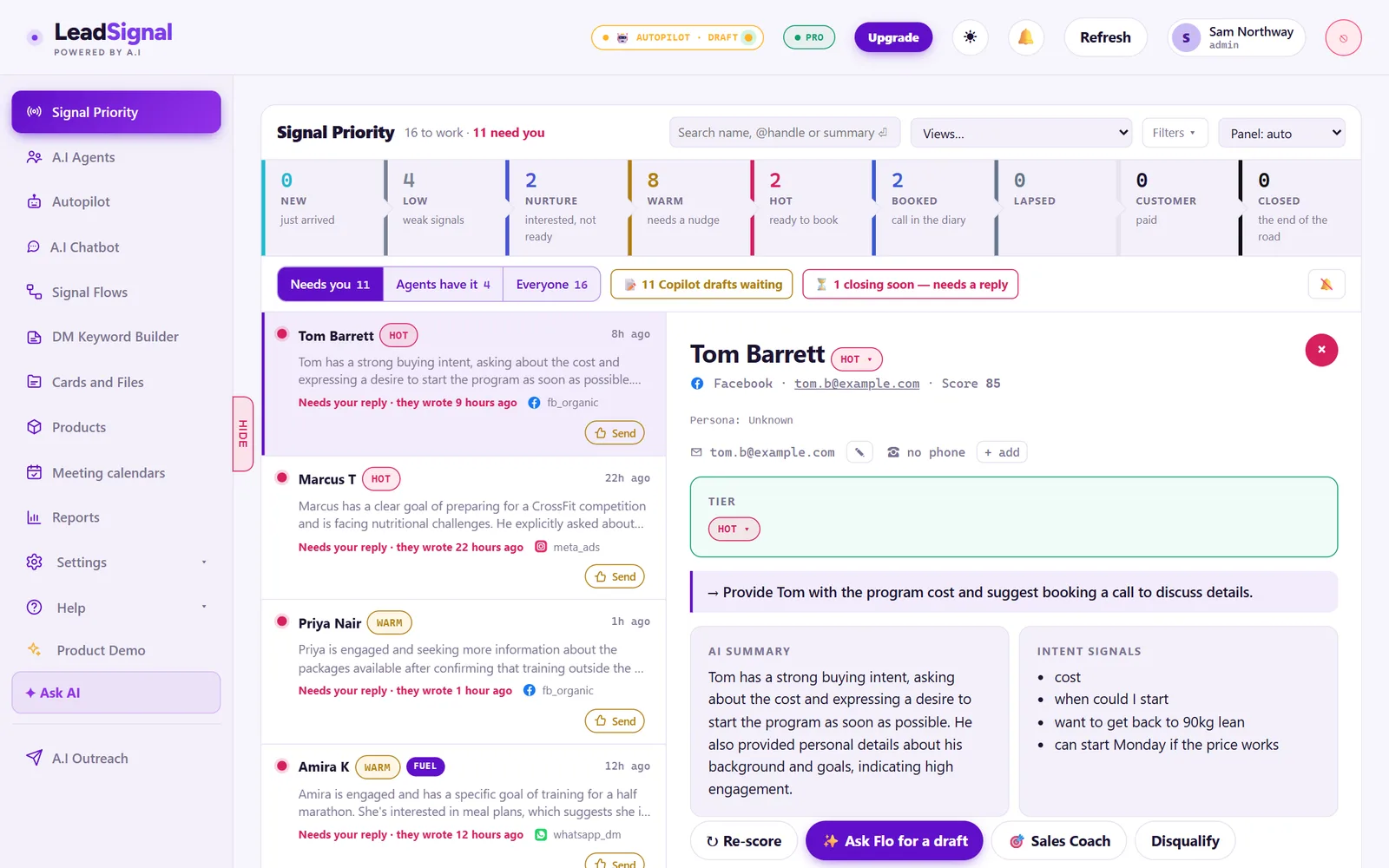
When setters look at the queue, the first five seconds should tell them: “who goes first, why, and what to ask.” Build your signal model around three categories.
1) Source and context
- Post type: Problem/solution posts yield warmer intent than general lifestyle posts. Prioritise DMs tied to explicit offers, frameworks, or outcomes.
- Entry path: Comment that requests next steps, story reply to a CTA, or form handover outranks a cold “hey”.
- Referral mentions: Name-dropping a client result or partner increases odds of fit.
2) Language and behaviour
- Specificity: “We’re stuck at £80k/mo and need a path to £150k” > “Need help with marketing”.
- Time framing: “Q3 launch” > “sometime this year”.
- Decision signals: “I run sales” or “I own the P&L” > “I’ll check with the team”.
- Responsiveness: Fast replies and out-of-hours engagement suggest urgency.
3) Negative filters
- Freebie-only intent: “Do you have a template?” after declining next steps twice.
- Scope mismatch: Requests outside your service (e.g., asking for something you deliberately don’t offer).
- Serial reschedules/no-shows: History matters. Down-rank but don’t delete unless they hit a threshold.
Put these signals on one screen for setters and automate the ordering. Your goal is to make the right decision the easy decision: the warmest, highest-fit conversations come to the top; the rest get the two-message loop and a sensible path.
Featured snippet: 7 steps to disqualify DM leads fast
- Define your fit grid and hard disqualifiers.
- Score intent signals (source, language, responsiveness).
- Reply with a two-message loop: context, then gate + next action.
- Use pre-approved micro-scripts for common non-fits.
- Keep AI on a short leash: human approval before send.
- Assign named ownership, SLAs and clear handoffs.
- Tag source and outcome to improve content and routing.
Ownership, handoffs and follow-up that protect genuine buyers
Even the best qualification logic fails without operational discipline. Build these into your daily rhythm:
- Single owner per conversation: If two setters reply, no one is accountable. Assign on capture and keep it until the state changes.
- SLA timers visible to the team: Time since last inbound. Time since last outbound. Escalate at thresholds (e.g., 15 minutes, 2 hours, 24 hours).
- Shift handover notes: If you run coverage, document last message, sentiment, and next action. Handoffs should feel invisible to the prospect.
- Comment-to-DM conversion SOP: For public comments with clear buying signals, reply publicly with a light acknowledgement and immediately move to DM with context copy-pasted. Don’t rely on the commenter to initiate the DM.
- Re-engagement cadences: For stalled but promising chats, use a 3-step pattern: value drop (short insight), relevance hook (tie to their goal), and a soft close (offer a 10-minute scoping call). Space these across 5–7 days.
These mechanics keep response times predictable, prevent “lost in the inbox” outcomes and ensure your warmest leads always feel like they’re speaking to a reliable team, not a rotating helpdesk.
Language that disqualifies without burning bridges
- Scope mismatch: “We specialise in [your niche outcome]. If that’s not the priority right now, here’s a quick brief that might help. When [trigger] shifts, send ‘READY’ and I’ll map options.”
- Budget mismatch: “Our typical engagement starts at [range] because delivery includes [2–3 essentials]. If you’re exploring lighter options, this overview outlines leaner paths — I’m here when the brief expands.”
- Timing too far out: “We usually join when teams want traction in 60–90 days. If you’re scoping for next year, shall I park a reminder for [month] and send you a short prep checklist?”
- No authority: “Is the decision with you or someone else? If it’s a group call, I can share a 1-page brief first so everyone’s aligned.”
Notice each response protects your time while offering a low-friction return path. That’s the balance: short, respectful and directional.
Reporting that shows which social work creates bookings
To scale, you need proof — not anecdotes. Reporting should answer three questions every week:
- Which posts and campaigns produce qualified conversations? Attribute every captured DM and comment to its source. Break down by content theme, CTA, and format. Prioritise what consistently yields high fit scores and short time-to-call.
- Where are qualified leads leaking? Look at stage-to-stage conversion inside the DM funnel: captured → responded → qualified → call offered → booked. If you see a drop between “qualified” and “booked”, inspect the handoff script and the booking flow friction.
- What improves when we adjust the gate? A/B the second message in your two-message loop. Measure impact on time-to-truth, qualified rate, and no-show rate. Keep the version that increases clarity without inflating call volume with poor fits.
Close the loop by connecting each conversation’s outcome to pipeline stages. That gives you social-to-revenue visibility and lets you make cleaner decisions about content, staffing and service focus.
Addressing common concerns about control and safety
- “Will this fit our existing social and booking flows?” Yes — design your gates and scripts around your current intake and calendar steps. The key is that DMs funnel into one prioritised queue with consistent next actions, not a dozen side threads.
- “Do setters stay in control?” Absolutely. Your process should automate sorting and drafting, not judgement. Setters approve sends, personalise where needed and own outcomes.
- “Is AI safe with live prospects?” Put it on rails: pre-approved questions, forbidden promises, and a blocked-phrases list. Route sensitive or high-intent messages to human-only handling.
FAQ
What’s the fastest way to qualify DMs without scaring people off?
Use a two-message loop: one context question followed by a gate and a clear next action. Keep each message short, respectful and directional, and offer a helpful path even when timing or budget isn’t right.
How many DM questions should I ask before offering a call?
Two or three focused questions are enough for high-ticket. If fit, authority and timing look good, offer the call. Longer interrogations increase drop-off and don’t materially improve call quality.
How do I track which posts turn into booked calls?
Tag every conversation with its source post or campaign and record the outcome stage. Review weekly to see which themes and CTAs yield qualified chats and booked calls, then feed that back into content planning.
Use this playbook to decide, with confidence, how to disqualify high-ticket DM leads quickly — and still make sure genuine buyers never slip past you.
The self-serve demo builds a workspace from your real setup — no card, no call.