How performance and social lead-generation agencies can prove social media lead attribution from an Instagram or Facebook comment to a booked call

If you run performance or social lead-gen programmes across Instagram and Facebook for multiple high-ticket clients, you face two constant pressures: deliver booked calls and prove exactly which social posts and campaigns created them. The operational reality is messy: comments, DMs and missed handoffs in client inboxes; ad and organic interactions interleaving; calendars and CRMs living in different places; and spreadsheets that no one fully trusts. This is precisely where social media lead attribution for agencies tends to fall apart.
It doesn’t have to. You can demonstrate a defensible path from a specific Instagram or Facebook comment to a booked call, without chasing client inboxes or stitching random exports together. The key is an operating model that captures the source at the moment of interaction, assigns clear ownership to setters, enforces response standards, and maintains a client-safe, auditable trail all the way into pipeline.
This article lays out that model in practical, operator-grade detail: source capture, lead ownership, setter SLAs, client-safe workspaces, post-and-campaign-to-pipeline reporting and a measurement framework you can implement today—while keeping client risk to a minimum.
Why attribution breaks — and the operating model that fixes it
Attribution fails in social-led demand for a handful of predictable reasons:
- The source touch is not captured with sufficient detail, or not captured at all.
- Multiple people reply from different devices and tools, fragmenting the conversation record.
- Comments and DMs live in client-owned inboxes, so agencies cannot see the full picture or resolve conflicts.
- Booking links are generic and lack traceable parameters, breaking the chain between social interaction and the calendar event.
- Spreadsheets are used to reconcile leads, but deduplication, timestamps and post/creative IDs are incomplete or inconsistent.
- CRM entries are created by different teams with different rules, leading to mismatched contact and deal ownership.
A simple, robust operating model corrects for this: 1) Capture the source event at the point of interaction. 2) Create or update a unified contact keyed to the social identity. 3) Assign clear lead and thread ownership to a setter with a prioritised queue. 4) Enforce response-time and quality standards with audit trails. 5) Use booking links or forms that carry immutable source parameters. 6) Reconcile the calendar event to the contact and the originating post/campaign. 7) Report on the full chain from post/ad to booked call, with clear definitions and quality checks.
Do this consistently, and you will stop chasing client inboxes and start presenting calmly defensible reporting that holds up in client reviews.
Source capture that proves the path from comment to call
Everything starts with the right data model. If you cannot prove the first eligible social touch and carry it forward into the calendar event, you will always be on the back foot.
Capture events with full context For each relevant social interaction, persist an event with immutable identifiers and contextual metadata:
- Comment event
- Platform: Instagram or Facebook
- Comment ID, Post ID, and if relevant Parent Comment ID
- User handle and platform user ID (hashed/stored compliantly), profile URL
- Timestamp (original and normalised to client timezone)
- Comment text snapshot
- Post type: organic or ad
- If ad: Ad ID, Ad Set ID, Campaign ID
- Media metadata: creative ID or hash, caption, link, CTA
- Message event (DM or private reply)
- Conversation ID and Message ID
- Direction: inbound or outbound
- Source linkage: which comment/post triggered the private reply (when applicable)
- Timestamp and message text snapshot
- Consent or opt-out status flags if captured
- Profile click or link-out (if trackable)
- Click timestamp and destination (bio link, landing page, booking link)
- UTM parameters and any lead key or session ID
Use official APIs and client-authorised connections to collect these events. Do not share passwords or rely on ad hoc forwarding; it creates client risk and breaks the audit trail.
Create a durable contact key Define a social_contact_key composed of:
- Platform + Platform User ID (e.g., instagram:17841400000000000)
- Optional: a hash of handle + platform if you cannot store the raw IDs
This key lets you unify comments and messages from the same person before you have an email or phone. When an email or phone later appears (in a form or booking), link it to the same contact. Maintain a merge history so you can show how two records became one.
Deduplicate and enrich consistently
- On comment or DM: find or create a contact by social_contact_key.
- On form or booking: find or create by email/phone; if a social_contact_key exists in session parameters or prior events within a defined time window, link them.
- Prefer additive merges. Do not overwrite fields with null values. Preserve source timestamps and event IDs for audit.
Carry immutable source parameters into booking Your booking links should always include:
- lead_key: the social_contact_key or a short-lived token that maps back to it
- source: platform and interaction type (ig_comment, fb_private_reply, ig_dm, etc.)
- content_id: Post ID (and Ad ID if applicable)
If a setter switches someone to a call application form, include the same parameters so you can reconcile form submissions and bookings back to the originating social touch. Make the parameters visible in the final calendar event metadata or a linked CRM activity so the evidence is reviewable.
Verify the booked call, not just the link click For booked calls, store:
- Calendar event ID and organiser
- Scheduled start time and the created-on timestamp
- Booker contact (email/phone/name) and matched contact ID
- Booking source parameters (from the link or session)
- Status updates: rescheduled, cancelled, no-show (if available)
This gives you a provable chain: Comment -> DM -> Booking Link with lead_key -> Calendar Event with the same lead_key.
Lead ownership and a prioritised setter workflow
Attribution collapses when multiple hands touch the same conversation or when setters lose time triaging disorganised inboxes. The solution is a queue-based workflow with unambiguous ownership.
Define ownership at two levels
- Contact owner: who owns the person across time. Used for nurturing and relationship continuity.
- Thread owner: who owns a specific conversation thread (e.g., this comment and the DM sequence that followed). Used for SLA accountability.
Auto-assign intelligently Use simple, defensible rules that suit your team size and client mix:
- Round-robin among active setters by client
- Capacity-aware assignment (e.g., limit the number of open threads per setter)
- Priority routing for high-intent signals (keywords, campaign tiers, product lines)
- Language or region-based routing where relevant
Make assignment visible in the UI and auditable in logs. If a setter does not respond within SLA, auto-rotate the thread to a backup and note the breach.
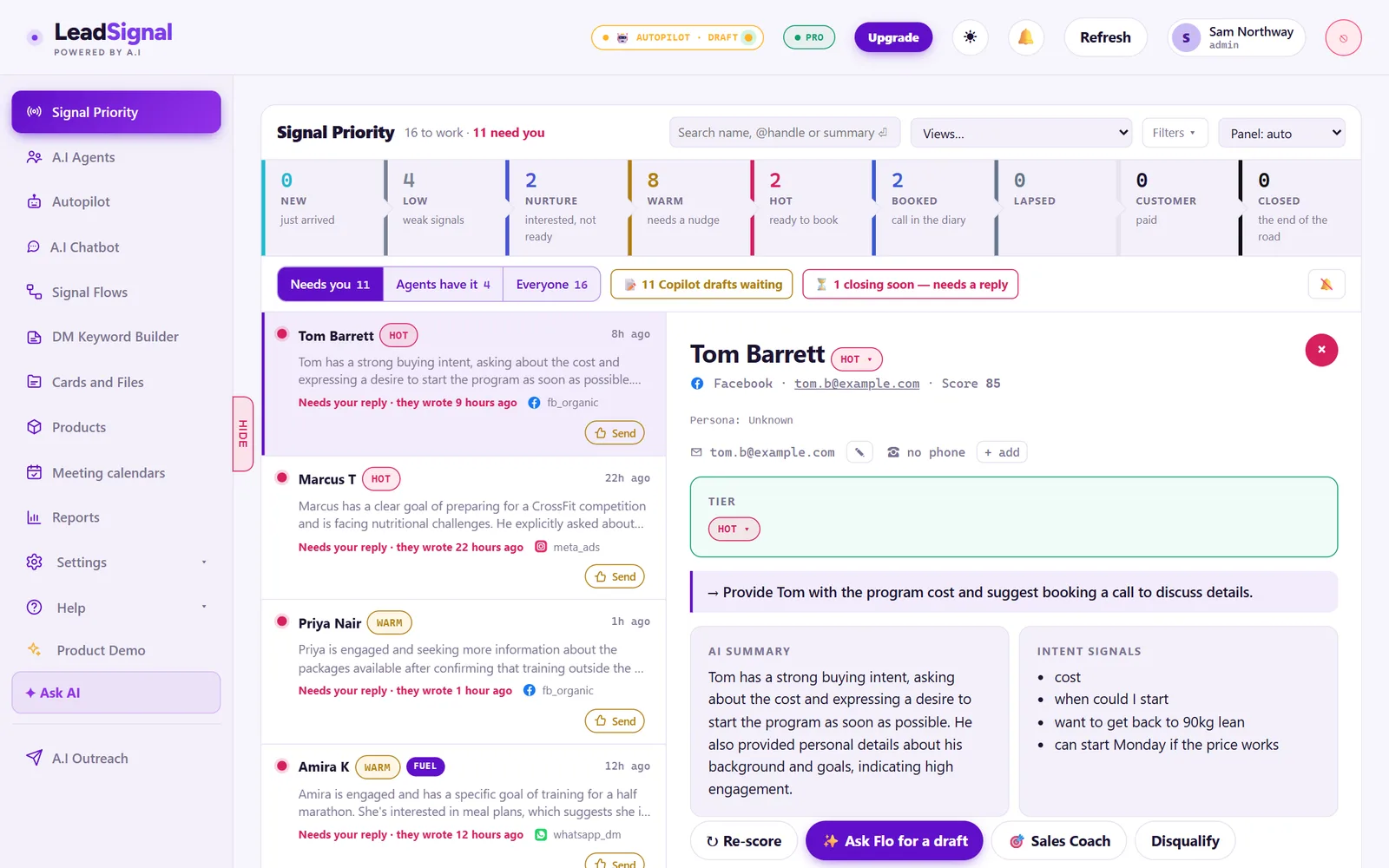
Prioritise what actually moves pipeline Your queue should rank items by:
- Recency (freshest interactions first)
- Intent (keywords like “price”, “book”, “location”, or comment semantics)
- Campaign/post tier (e.g., launch posts or retargeting ad comments)
- Relationship status (return contacts vs. net-new)
- Time-sensitive contexts (live events, stories)
Expose only one “work next” list per setter to avoid context switching. Include one-click actions: reply, escalate, book, qualify/disqualify, set reminders.
Standardise statuses and outcomes Keep it simple and mutual-exclusive:
- New
- Engaged (replied)
- Qualified (meets client-defined criteria)
- Booked (calendar event created)
- Nurture (not now, but potentially later)
- Disqualified (with reason code)
- Unresponsive (with time-based closure)
Record structured reason codes (budget, timing, wrong fit, location, duplicate) to improve reporting and creative decisions later.
Connect to CRM without creating chaos Push only clean, meaningful updates:
- Create or update a contact when you have an email or phone
- Log a social interaction activity with the source parameters
- Create a deal/opportunity only when the client’s agreed trigger is met (e.g., Qualified or Booked)
Avoid round-tripping every minor interaction. The CRM should reflect milestones; your conversation system should manage the messy middle.
Setter response standards you can enforce and report on
Even perfect attribution data won’t convert if response speed and quality slip. Set explicit, measurable standards and report on them per setter and per client.
Set time-based SLAs that reflect the channel
- Public comments: first reply within 5 minutes during staffed hours; 15 minutes outside peak hours
- DMs: first reply within 10 minutes during staffed hours
- Follow-ups: no more than 24 hours between setter messages unless the lead has paused
Define staffed hours per client, considering their audience timezones. Use an “after-hours” macro pointing leads to a booking link or asking for preferred times.
Codify qualification criteria with examples Write clear, client-approved definitions for Qualified. For example:
- ICP fit indicators (role, budget range, location)
- Problem statements that map to the offer
- Engagement signals (shared assets reviewed, demo video watched)
Include examples of good and bad qualifiers so setters can make consistent calls.
Build a lightweight template library Use templates to keep quality and speed consistent, not to sound robotic. Useful categories:
- First reply to public comment (helpful, moves to DM without spammy phrasing)
- First DM after public comment engagement
- Clarifying questions to qualify
- Transition to booking (with persuasive framing)
- Post-booking confirmation and expectation-setting
- Graceful disqualification with a value add
Require light personalisation: name, reference to their comment, and relevant benefit. Track template performance (usage vs. booked rate) and prune underperformers.
Ensure compliance and consent
- Respect platform policies on private replies and unsolicited messaging
- Make opt-out mechanisms clear and honour them
- Avoid collecting sensitive data in DMs; route to secure forms when needed
Audit and coach continuously
- Sample conversation reviews weekly per setter
- Score against response time, brand tone, qualification accuracy, and CTA clarity
- Feed insights back into templates and creative briefs
Client-safe workspaces and permissions that reduce risk
Agencies need robust control without putting client brands at risk. The safest pattern is strict separation, principle-of-least-privilege permissions and auditable access.
Separate workspaces per client
- Isolate data: posts, comments, messages, contacts, bookings and reports live in a client-specific workspace
- Prevent accidental cross-client visibility by staff who straddle multiple accounts
- Provide a clean audit export if the client insources or changes agencies
Use roles that match agency reality
- Admin: configure connections, manage users, set SLAs and automation
- Strategist: edits templates, campaigns, routing rules
- Setter: handles conversations, books calls, updates statuses
- Analyst: reads all data, exports reports
- Client viewer: read-only dashboards, no message send rights
Avoid credential sharing
- Authenticate to Facebook and Instagram via official, client-approved connections
- Do not store personal passwords
- Ensure revocation is simple and immediate if roles change
Control who can speak as the client
- Require explicit permission to send outbound messages as the brand
- Provide draft/approve workflows if the client wants oversight on certain templates or scenarios
- Log every outbound message with user attribution and timestamp
Protect data and privacy
- Retain only necessary fields; hash or tokenise platform IDs where policy requires
- Allow configurable retention windows for messages and PII
- Provide secure exports for client data requests and end-of-contract handoffs
This “client-safe by design” posture eliminates the fear of “another tool” by making boundaries and controls obvious and auditable.
Post, campaign and ad-to-pipeline reporting clients will trust
You earn trust not with flashy charts, but with consistent definitions and traceable chains from creative to calendar.
Build an attribution chain for each lead For every contact who books, store a simple ordered chain:
- Touch 0: First eligible social touch (e.g., IG comment on Post ID 123 at 14:03)
- Touch 1: First DM (e.g., IG DM at 14:05, content summary)
- Touch 2: Booking link click (with parameters)
- Touch 3: Calendar event (with event ID and status)
- Optional: Additional touches (retargeting comment, follow-up DM)
Surface the chain in reports and exports. When a client asks “Which post did this call come from?”, you can click into the chain and show the evidence.
Report at the levels clients care about
- Post-level: comments captured, replies sent, DMs started, qualified conversations, booked calls
- Campaign/ad-level (for paid): same metrics, rolled up by Ad/Ad Set/Campaign
- Channel mix: organic vs paid contributions to qualified and booked
- Setter performance: response time, SLA adherence, conversion to booked
- Time-based trends: week-on-week booked calls, seasonality, launch windows
Integrate spend carefully If you manage paid, align booked calls to spend windows and report cost per booked call. If you do not manage spend, avoid guessing. Either import spend from the ad platform or omit cost metrics.
Show integrity checks before the headlines Include a small “data quality” panel so clients understand the foundation:
- Percentage of bookings with a source chain
- Orphaned bookings (no social source) and how they were handled
- Duplicate contact merge rate
- SLA breach rate (affects conversion)
This reduces the back-and-forth in QBRs and reframes the conversation on outcomes and improvements.
A practical measurement framework for social media lead attribution for agencies
A framework keeps everyone aligned—from setters to analysts to the client’s RevOps team. Define entities, metrics and rules up front.
Core entities
- Post: the published unit on Instagram or Facebook (organic or ad)
- Interaction: comment, reaction, DM or private reply
- Contact: the person, unified across social IDs and later email/phone
- Thread: a discrete conversation episode linked to a post or purpose
- Booking: the scheduled call object from your calendar tool
- Campaign: paid or organic initiative that groups posts/ad units
Key definitions
- Captured comment: a comment event persisted with user ID, post ID and timestamp
- Replied comment: a public reply or private reply sent by your team
- DM start: first inbound DM from a contact within a thread window (e.g., within 7 days of the related comment)
- Qualified conversation: a thread marked Qualified per client-defined criteria
- Booked call: a calendar event created with source parameters that match to the contact and thread
- Influenced: a booked call where the contact had a qualifying social interaction within X days prior (define X, e.g., 30)
Essential metrics and formulas
- Capture rate = (Captured comments) / (Total detectable comments on tracked posts)
- Reply rate = (Replied comments) / (Captured comments)
- DM conversion rate = (DM starts) / (Replied comments)
- Qualification rate = (Qualified conversations) / (DM starts)
- Booked rate = (Booked calls) / (Qualified conversations)
- Time to first response (median)
- Time to book (median from first interaction to booking creation)
- SLA breach rate = (Threads with initial response beyond SLA) / (All assigned threads)
- Orphaned booking rate = (Bookings with no source chain) / (All bookings)
Attribution rule set
- Source of truth: first eligible social touch is the source unless a later social touch more directly precipitates the booking within a defined attribution window
- Deduplication: if multiple comments/DMs exist, credit the most recent qualified thread within the window; if none qualified, credit the first touch
- Paid vs organic: inherit from the post/ad metadata in the source event
- Multi-post interactions: allow “assists” for diagnostic purposes but keep primary credit to a single source for clarity unless the client requests multi-touch models
Review cadence
- Daily: setter queues, SLA breaches, urgent comments from launch posts
- Weekly: campaign/post performance, template performance, audit samples, QA trends
- Monthly: source-to-booked trends, creative insights, setter capacity/coverage, integrity checks
- Quarterly: model review (windows, qualification criteria), cross-client learnings
Implementation checklist
- Connect official Instagram and Facebook accounts via client authorisation
- Start capturing events with the fields listed above
- Define and enable deduplication and merge rules
- Roll out booking links with lead_key, source and content_id parameters
- Configure routing and ownership rules; train setters on statuses
- Set SLAs by channel; monitor and alert on breaches
- Publish a template pack and codify qualification criteria
- Build dashboards for post/campaign-to-booked and setter performance
- Pilot with one client for two weeks; validate attribution chains end-to-end
- Document the operating procedure and share client-safe views
Common pitfalls to avoid
- Relying on screenshots as “proof” without IDs and timestamps
- Letting setters operate directly in native inboxes with no central capture
- Using generic booking links that drop source parameters
- Pushing every interaction into the client CRM and overwhelming their RevOps team
- Overcomplicating attribution with multi-touch models before the basics work
- Ignoring privacy and permissions; always use authorised connections and least-privilege roles
Putting it together: a client-safe operating model that scales
With the pieces above, your daily reality changes:
- Setters work from a single prioritised queue, not scattered notifications.
- Every reply and DM is logged against a contact and a thread with a visible SLA.
- Booking links carry immutable source parameters; calendar events inherit them.
- Reports show post/ad-to-booked chains with integrity checks.
- Clients see only what they need in a read-only workspace, with no exposure to other accounts.
- Your team can defend performance calmly in reviews because the evidence is traceable.
This is social media lead attribution for agencies done properly: rigorous source capture, clear ownership, enforceable standards and defensible reporting.
Want to see this operating model in action without adding client risk? Book a short LeadSignal demo to see how agencies capture source-to-booked chains, prioritise setter workflows and present client-safe attribution their accounts trust.
The self-serve demo builds a workspace from your real setup — no card, no call.