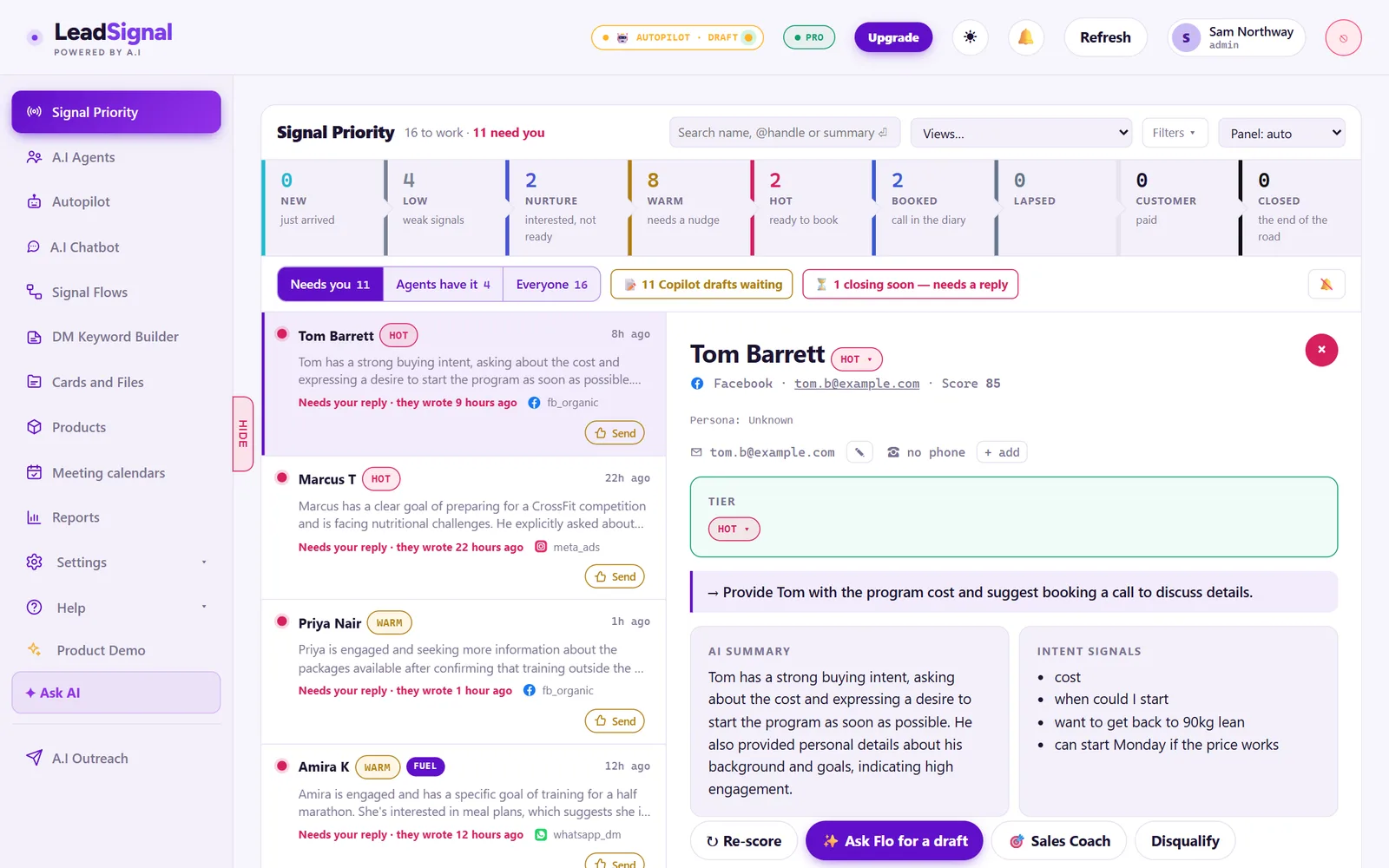
Inside LeadSignal's AI Autopilot: Smart Lead Intelligence for Every DM

Every high-ticket DM pipeline has the same weak point: the gap between a lead messaging and a human actually replying. During that gap the lead is deciding, often within minutes, whether you are worth their time. AI Autopilot exists to close that gap without handing your brand voice to a script that says the same five things to everyone. It reads each conversation, scores it, drafts a reply worth sending, and tells you afterwards what actually happened across the whole pipeline, so the intelligence sits on top of your judgement rather than replacing it.
The phrase "AI automation" tends to worry people who sell on relationship and trust, and reasonably so: a lot of what gets sold as automation is a script that fires the same message at everyone regardless of what they actually said. Autopilot is built the opposite way round. It exists specifically for businesses where the DM itself is part of the sale, so every piece of it is designed to protect the quality of that conversation while removing the operational drag of running it at volume.
This matters most for the businesses that most need it: a solo coach or a small setter team handling a genuine volume of inbound interest, where "just reply faster" is not a plan, it is an instruction with no mechanism behind it. Autopilot is the mechanism, and the rest of this article walks through what each part of it actually does.
What "AI Autopilot" actually means
Autopilot is not a single feature, it is four connected pieces working on the same conversation: a setter that reads and drafts, a scoring model that ranks urgency, a recommendations engine that reads the whole account and says what to change, and a response-time report that shows where replies are actually slow. Together they turn a DM inbox from a queue you triage by feel into a queue ranked by evidence.
None of the four pieces is useful on its own for very long. A setter that drafts replies but has no scoring to prioritise against will draft in arrival order, wasting speed on low-intent messages. A scoring model with no drafting attached still leaves someone to write every reply by hand. The value is in the four working on the same live data, continuously, rather than as four separate tools someone has to remember to check.
The AI setter: drafts, not decisions
When a message comes in, Autopilot reads the conversation history, drafts a reply, and puts it in front of a human to approve, edit or send as-is. The point of keeping a human in the loop is not caution for its own sake: it is that a coach or a setter catches the one message a week that genuinely needs a human judgement call, while the AI carries the ninety-nine that do not. That balance is what makes fast replies sustainable instead of a compliance risk.
Lead scoring and tiers: know who to answer first
Not every DM deserves the same speed of reply. Autopilot scores each conversation on buying intent and puts leads into tiers, so a setter opening their queue in the morning sees the hottest conversations first instead of working through messages in the order they happened to arrive. A lead asking about price and availability outranks someone who liked a post and said "nice", and the queue reflects that automatically.
Draft-then-learn: Autopilot writes in your voice, not a generic one
A templated chatbot voice is the fastest way to make a warm lead go cold. Autopilot starts by drafting conservatively and improves as it learns from what you actually approve, edit and send, so the replies converge on how you genuinely talk to prospects rather than a generic sales script. The result reads like you, because it is trained on you, not on a library of stock objection-handling lines.
The learning is deliberately gradual rather than a one-off training exercise. Every edit you make to a draft is a signal about phrasing, tone and how you actually handle a specific objection, and those signals accumulate over time. This is also why draft quality tends to improve fastest in the first few weeks of real use: the more genuine correction it gets, the closer the default draft gets to something you would barely need to touch.
Lead tiers: turning a score into a clear next action
A numeric score is only useful if it changes what a setter actually does next. Autopilot groups scored conversations into tiers, so instead of interpreting a raw number, a setter sees a small number of clearly defined groups: ready to book, warm and worth a follow-up, or early-stage and worth nurturing rather than pushing. That structure turns scoring from an abstract number into a concrete, repeatable action for every conversation in the queue.
AI Recommendations: what to change, not just what happened
Most reporting tells you what happened last week. AI Recommendations reads your whole account, funnel and Autopilot behaviour and tells you what to change: a keyword that is under-converting, a follow-up step that is too slow, a flow that is quietly losing leads at the same point every time. It is the difference between a dashboard and a second pair of eyes on your pipeline.
The reason this needs to be AI-driven rather than a static report is volume and pattern-matching. A human reviewing a month of conversations can spot one or two obvious problems, but a pattern that only shows up as "leads who ask this specific question convert at half the rate of everyone else" is genuinely hard to notice by eye across hundreds of conversations, and exactly the kind of thing worth knowing before you spend another month running the same flow unchanged.
Response-time intelligence: find the leak before it costs you a deal
Speed to first reply is one of the strongest predictors of whether a DM ever becomes a booked call, and it is also the easiest thing to lose track of once volume grows. The response-time report shows exactly where replies slow down: which hours, which channel, which stage of the conversation, so you can fix the actual bottleneck instead of guessing that "we should just reply faster."
This is usually the most eye-opening part of Autopilot for a business that has never measured it before. It is common to discover that weekday daytime replies are genuinely fast, while evening and weekend messages, often the moment someone finally has time to look seriously at a purchase, sit for hours. That single gap, once visible, is frequently worth more to fix than any amount of extra content or ad spend, because the leads were already arriving; they were simply waiting.
What stays a human decision, on purpose
It is worth being explicit about where Autopilot deliberately stops. It does not decide pricing, it does not commit to anything on your behalf without approval by default, and it does not pretend to be a person if you would rather it identify itself as AI-assisted. The design principle behind all four pieces is the same: remove the operational cost of speed and consistency, and leave the judgement calls, the pricing conversation, the genuine objection handling, the moment a deal actually closes, with the human who is accountable for them.
How the four pieces work as one system
- A message arrives on any channel and Autopilot scores it for buying intent.
- The AI setter drafts a reply in your learned voice, ready for approval.
- The response-time report tracks how quickly that draft actually reached the lead.
- AI Recommendations periodically reads all of the above across your whole account and tells you what pattern to change next.
None of these pieces is impressive alone. Together, they mean the busiest hour of your week is the one Autopilot handles best, and the quiet hour afterwards is when you review what it did and tighten it. Most accounts settle into a rhythm where the AI carries the volume, the human reviews a small sample and handles the genuinely hard conversations, and AI Recommendations does the periodic step back that nobody has time to do manually: reading the whole pipeline and pointing at the one thing worth fixing next.
Try LeadSignal to see Autopilot scoring and drafting against your own conversations.
FAQ
Does AI Autopilot send messages without a human seeing them first?
By default, Autopilot drafts replies for a human to approve, edit or send. Whether and when replies go out with less manual review is a setting you control, not a fixed behaviour.
How does lead scoring decide which conversations are hottest?
Scoring reads the content and pattern of a conversation for buying-intent signals, such as questions about price, timing or availability, and ranks conversations into tiers so the setter queue reflects urgency rather than arrival order.
Does Autopilot's writing style actually change over time?
Yes. Drafts are refined based on what you approve, edit or reject, so the voice moves closer to how you actually reply the more it is used and corrected. This benefits a solo coach handling their own DMs as much as a larger setter team, since the underlying problem, the gap between a message arriving and a genuine reply going out, exists at any size of operation.
The self-serve demo builds a workspace from your real setup — no card, no call.